5 things I wish I'd known about oil painting
When you first start painting, there’s so much to learn. Everything is new, and it can be hard to know what’s true, what really matters, and what will actually help you improve.
Looking back on all the things I’ve learned about painting over my lifetime, there are a few I really wish I’d known when I first picked up a brush. It would have made the whole experience better and saved me some unnecessary frustration.
So let me save you some time. Here are 5 things I wish I’d known sooner.
#1: You are NOT required to use linseed oil as your medium
Linseed oil is a very old medium. And it's a good medium, but it can be slow drying. So if you want to be able to paint again the next day — rather than waiting forever — then an alkyd medium, like Liquin, is the key.
Alkyd mediums have been around now for more than 50 years, and the drying speed is what allowed me to start painting in oils again when I was illustrating children’s books and on a deadline. Now that I think of it, I guess I’ve been using Liquin for more than 20 years.
These days, there are a lot of different alkyd mediums, but Liquin is still my go-to medium for faster drying times.
#2: I wish I'd known to use a medium instead of solvent to thin the paint
When you use a solvent, you're breaking down the bond of the paint, because that's what solvent does. But I was also using it to thin the paint to make it move, or for creating different effects. Nobody told me you shouldn’t do that.
While you can use solvent during the early stages (like during the underpainting), if you continue to thin your paint with solvent, it could create a problem. Mediums are a much better option. (I talk more about why you should use mediums in this post.)
What kinda problems do I mean? Well, that brings me to fat over lean…
#3: I wish I’d known the fat over lean rule
In simple terms, fat = more oil, and lean = less oil. So fat over leans means in the beginning you want leaner layers, or less oil. As you get farther into subsequent layers, you can add a more fat — typically with a medium. The idea is to create nice flexible layers that are bonding well so you don't run into problems later on.
Trust me, it's not as complicated as it may sound. But it is important to understand so you don't end up with unexpected consequences. (Be sure to read this post to learn more about fat over lean.)
#4: You don’t HAVE to use a direct, alla prima technique
The other thing that I wish I'd known earlier is that you don't have to paint directly. That's the way a lot of people learn these days. It's the way I initially learned. But the classical approach, painting in layers and stages, is a much more relaxed and forgiving approach.
Let me back up, though. What do I mean by direct alla prima? It's an Italian phrase which basically means "first attempt" or "at once." It's when you paint in a single layer (more or less) with a lot of paint on the brush. Which typically means you're painting relatively quickly.
The 19th century impressionists really popularized this approach, with their bold, loose, brushstrokes and visible brushwork.
This approach also means you're applying wet paint on wet paint, and you're addressing all aspects of your painting at once: values, colors, composition, perspective, etc.
(If you like painting directly, that’s fine, too! There’s nothing wrong with that approach. It’s just very different from painting in layers.)
By contrast, indirect painting is done in layers, wet on dry. And you're addressing different aspects of your painting at different stages.
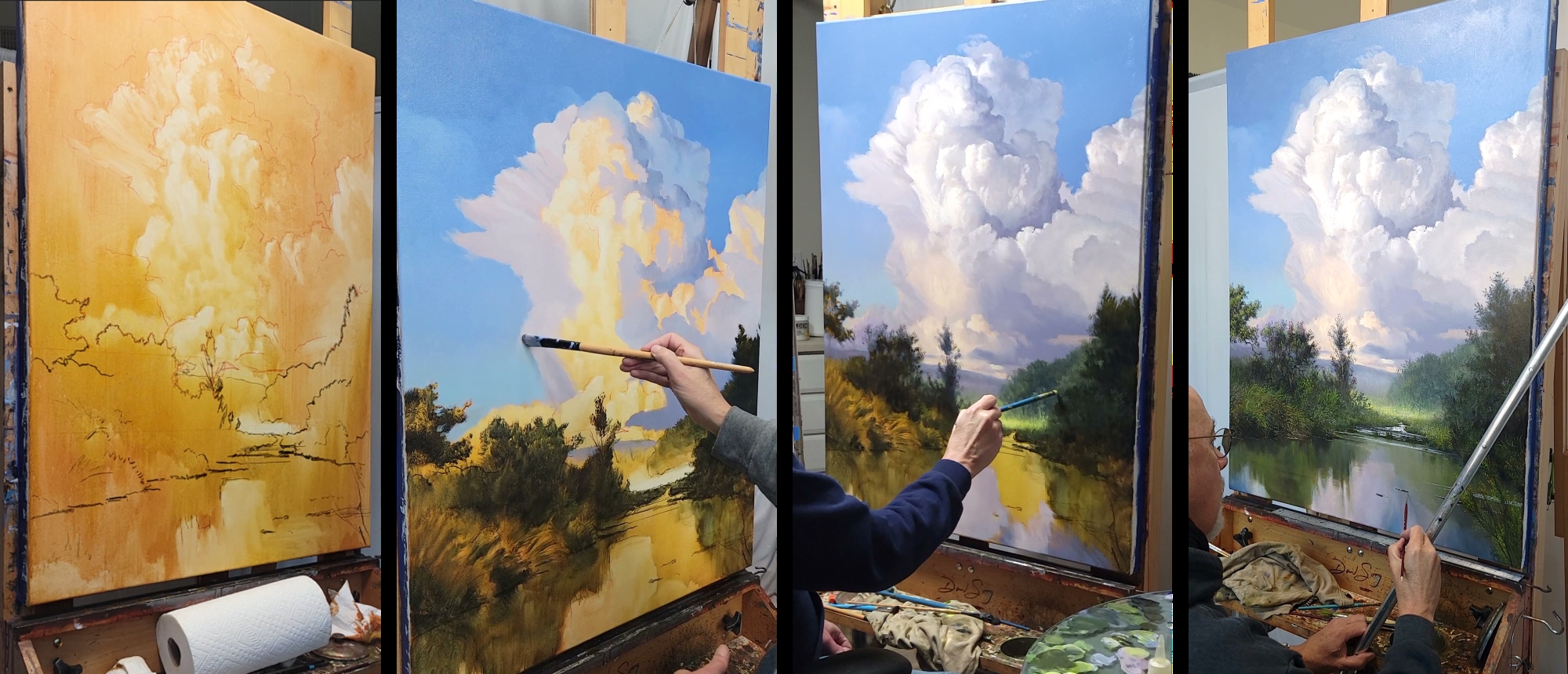
Quiet Solitude, 40x30, Oil on canvas
Truthfully, though, as you gain more experience, you can combine both approaches. For example, sometimes I'll nail the sky on the first go. Other areas of the painting may require multiple layers to finish. There's no right or wrong, there's just what works for you.
(If you'd like to learn more about the classical approach I teach, be sure to register for my free workshop.)
#5: Painting doesn’t have to be a race
And last, but certainly not least, painting does not have to be a race. Unless of course, you’re painting outside en plein air, and you are in a race against the time, light or weather.
But if you’re painting indoors, you can take your time.
Remember, it’s not about how many paintings you can “get done” – it's about enjoying the process of painting so you can enjoy the journey.
Yes, I enjoy painting directly when I'm outdoors. But in the studio, I typically paint indirectly. And personally, I find painting in a classical manner a much more relaxing and enjoyable way to paint.
Bottom line: It's your journey
I tell my students all the time, "There's no ONE way to paint." There are lots of ways. And I think it useful to try the various methods. That's how we learn. And that's also how you discover what you enjoy the most.
Just remember, it's YOUR painting journey. So embrace it.
Learn. Paint. Repeat.
It's the same for me Every. Single. Day. What more could you want?
Take the next step
If this post helped clarify some of the foundational ideas that make painting easier, I’d love to invite you to my free workshop:
Secrets to Painting Beautiful, Realistic Landscapes
In it, I walk you through the classical approach I use in my own paintings — from the first toned canvas to the final refinements.
👉 You can watch the free workshop here.
When you understand the why behind the process, painting becomes a whole lot simpler — and a lot more enjoyable.
Related Reading
Why You Should Use Mediums in Oil Painting
Oil painting mediums don’t have to be confusing. Learn what they do, when to use them, and how they improve drying time, flow, and paint handling.


